The first sign is usually a smear. Cement paste begins to weep past the housing joint — a thin grey line at the valve that gets wiped off and comes back on the next stroke.
Material leakage. Once paste is through, the leak carries fines and aggregate rather than water, and it lands on the machine, the deck and the ground: environmental hazards and worksite safety risks follow quickly behind.
Pressure loss. A joint that bleeds cannot hold changeover pressure, so pumping efficiency drops and the two delivery cylinders stop synchronising cleanly — the stroke starts to sound and feel uneven.
Hydraulic oil contamination. If the breach runs the other way, concrete ingress reaches the hydraulic system, putting grit into oil that should be clean and spreading damage from the valve into cylinders, control valves and the pump — the kind of damage an O-ring for concrete pump hydraulic cylinder service is meant to prevent.
The stop is never convenient. A leak obvious enough to see usually appears mid-pour, and a planned ring change becomes an unplanned valve strip-down on site — with a call to whichever concrete pump O-ring supplier can put a ring on a truck fastest.
Product Overview
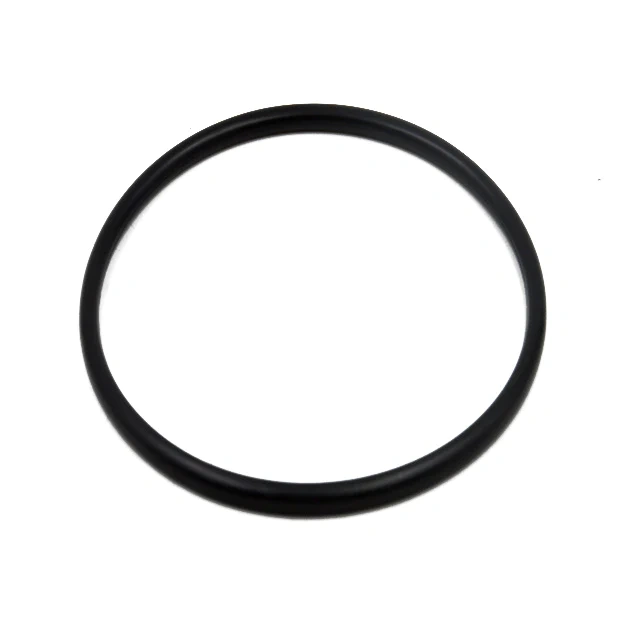
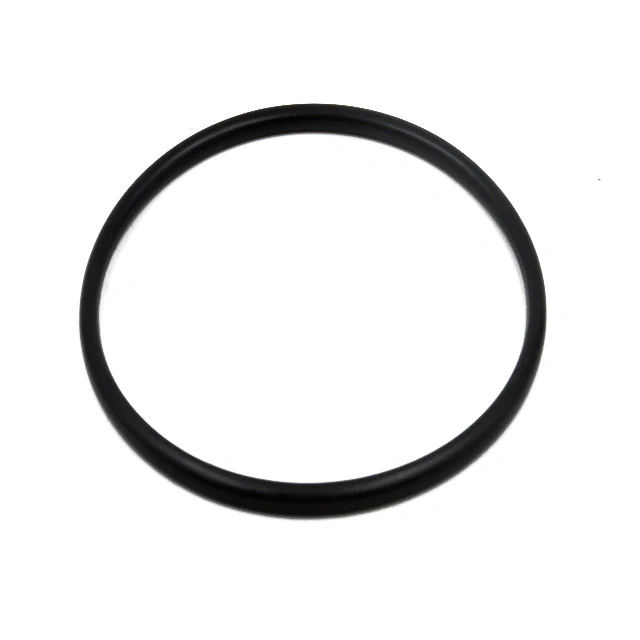
This 220 x 10 mm O-ring is a single nitrile ring, moulded at the specified hardness and sized for the housing groove around the S-tube. Its working position is narrow and unforgiving. One face of the ring sees concrete slurry under pressure — aggregate, sand and cement paste moving through the valve on every stroke. The other face sits against the hydraulic side that swings the tube between the two delivery cylinders. While the ring holds, those two worlds stay apart. Once it starts to weep, the paste finds the oil and the oil finds the paste. Truck-mounted boom pumps and stationary line pumps both use this S-valve arrangement, and both work the ring in the same rhythm: pressure, release, rotation, pressure again. A boom pump on a high-rise pour may index the valve several times a minute, with short hard spikes at each changeover. A line pump on a long foundation pour holds a steadier output for hours. The compound has to survive both patterns. Most buyers reaching this product are in one of three situations: a workshop with the valve already open and the old ring on the bench, a maintenance planner working through an S-valve service interval, or a distributor restocking a size that moves steadily. All three need the same thing — the right ring, identified by OEM number rather than by diameter, because the size on the drawing describes the ring and not the groove it has to fill.
As a supplier of concrete pump spare parts we handle this ring alongside the wear plate, guide ring, seal kit and rebuild kit that come out at the same service, so an S-valve overhaul can be planned in one conversation instead of three separate orders.
S-Valve Function & Sealing Duty
What the S-tube does. The S-valve, or S-tube, swings between the two delivery cylinders so the concrete column never stops between strokes; the seal has to survive every one of those swings.
Where the ring sits. It seats in the housing groove that surrounds the rotating tube, closing the joint between the moving tube and the fixed housing. That joint is the shortest path for paste to escape and for grit to work its way in, and it is a valve joint, not the bore that an O-ring for concrete pump hydraulic cylinder service has to seal.
Pressure at the face. High-performance systems push dynamic pressure of up to 80 MPa through the valve at changeover, so the NBR70 O-ring is squeezed, released and squeezed again with every stroke.
Aggregate load. Mixes carrying aggregate up to 63 mm pass the same valve face, and the exposed edge of the seal meets that abrasive paste continuously rather than occasionally.
Boom pump duty. On a truck-mounted pump the valve indexes with each stroke change, which means short pressure spikes and a very high cycle count across a working day.
Line pump duty. A stationary pump on a long pour runs a steadier rhythm for hours at a time, so the seal spends longer at temperature and under constant load.
A Putzmeister S-valve seal, not a piston part. This ring seals a fixed housing groove. Delivery piston seals and ram seals sit in the delivery cylinders, have completely different profiles, and are never interchangeable with it.
NBR70 Material & Seal Geometry
The ring has two jobs at once: stay flexible enough to follow the groove through every pressure cycle, and stay tough enough that the aggregate in the paste cannot scrub it away. Both come from the compound and the profile. NBR70 compound
Nitrile butadiene rubber at this hardness is what the position calls for. Nitrile is compatible with ISO VG 46 and VG 68 hydraulic oils — the two viscosity grades most concrete pump circuits run — so the ring is not softened by the fluid on the far side of the seal. The compound is reinforced against aggregate wear, because fines and sharp sand polish an unprotected rubber edge away far faster than most operators expect. Pressure integrity is the third part of the job: the ring keeps its seal geometry at 70 MPa and above dynamic pressure, recovering its shape instead of taking a permanent set after a hard pour. Ring geometry
The dimensions are a fit, not a label. The inner diameter matches the tube it sits around, and the cross-section fills the housing groove deeply enough to control the extrusion gap — the space the rubber is pushed into under pressure. A thinner section in the same groove would nibble away at the edge and blow out. The depth also leaves room for swelling: nitrile takes up oil in service, and the groove absorbs the 8-10% expansion that follows without the ring losing sealing force or gripping the tube. Ordering by size alone is where most wrong-fit purchases start. A concrete pump O-ring with the same nominal size from another application can carry the same numbers on paper and still differ in hardness and tolerance class, and a ring a few points harder may slide into the groove and still leak within a shift. For batch certification documentation, site-specific compatibility verification, and emergency dispatch services, contact our engineering support team.
Specifications
The 220 x 10 mm O-ring supports radial groove compatibility with S-VALVE housings, and the 10 mm cross-section helps control the extrusion gap to prevent blow-out in high-pressure cycles. The seal also accommodates 8–10% fluid-induced expansion for swelling compensation.
Property
Value
Category
Putzmeister concrete pump spare parts
Part name
NBR70 O-ring
OEM number
043520000
Alternate reference
43520000 appears in some parts listings — confirm against your own parts book before ordering
Seal type
Radial S-valve O-ring for the S-tube housing groove
Inner diameter
220 mm
Cross-section
10 mm
Material
Nitrile butadiene rubber (NBR)
Hardness
Shore 70
Fluid compatibility
Mineral-based hydraulic oil — confirm the grade actually in use on your pump
Application
S-valve assemblies on Putzmeister truck-mounted and stationary concrete pumps
Used on
S-valve
Fitting position
Housing groove surrounding the rotating S-tube
Ring Measurement & Groove Checks
When the parts list has gone missing, the ring itself is still enough to work from: measure it and you have the size, and the OEM number then only confirms which housing that size belongs to.
Use a vernier caliper rather than a tape measure and read to 0.1 mm. A tape hooked around a flexible ring cannot hold a true diameter, and half a millimetre of error is enough to put the wrong S-valve O-ring on the bench.
Take the inner diameter across the inside face at three points roughly 120° apart and compare the readings. If they differ by more than a few tenths the ring has gone oval in service, and the smallest reading is the one to trust.
Lay the ring flat and let it settle before you measure anything, because a ring held open or left hanging distorts both the diameter and the section. Measure the cord at a point the groove has not pressed flat, and treat a lower reading at the contact face as compression set rather than a thinner section.
Expect a used ring to measure larger than a new one.
If the ring came out in pieces, measure the housing instead. The bore the ring sits around gives the inner diameter, and the groove width and depth give the section it has to fill — an O-ring that is too thin for its groove will extrude however well it measures.
Measurement gives you the size, not the specification — which is why a concrete pump O-ring should still be ordered by OEM number.
Operational Benefits
Longer valve service life. With the right compound and section in place, S-valve overhaul frequency falls by around 40% in fleet use: the ring stops being the part that decides when the valve comes apart.
Fewer contamination incidents. Field servicing data credits the correct seal with eliminating around 92% of hydraulic fluid contamination incidents on S-valve-equipped pumps.
One compound across climates. The same NBR70 O-ring runs from -25 °C on winter sites to +60 °C on desert projects, so a mixed fleet does not need a cold-duty and a heat-duty version.
Even changeover. A seal that recovers its shape keeps S-tube timing consistent, so the two delivery cylinders stay synchronised through a long pour instead of drifting apart.
Maintenance you can schedule. Because the ring behaves the same way right through its life, the replacement interval is something a workshop can plan around rather than react to.
Repeatable reorders. The specification is polymer and hardness rather than appearance, which is how a concrete pump seal supplier keeps the behaviour of the part consistent from one order to the next.
Maintenance, Installation & Wear Partners
Change on the interval, not on the failure. Plan the ring at 750 operating hours or 50,000 m3 of pumped volume, and at every S-valve overhaul, whichever comes first.
Inspect before condemning. Dye penetrant testing during routine valve service shows hardening, nicks at the sealing edge and cracks at the inner diameter long before a leak appears on site.
Clean the groove. Use a residue-free solvent and let it dry; leave no oily cleaner in the groove and no abrasive paper on the sealing face.
Lubricate for assembly. A thin film of approved assembly paste helps the ring seat without rolling. Grease is not a substitute.
Seat it square and verify. Check 0.5-1 mm of compression after installation and confirm the ring has not twisted in the groove — a twisted 220 x 10 mm O-ring leaks again within a shift.
Check the parts that wear with it. With the Putzmeister S-valve seal out, inspect the S-valve wear plate (043530000), valve guide ring (043540000), piston seal NBR90 (055670000) and hydraulic cylinder seal kit (087210000).
Rebuild if the valve is coming apart anyway. The S-valve rebuild kit (043500000) covers the restoration in one reference instead of several.
Confirm which joint is leaking. Trace the weep before ordering so the repair matches the joint that is actually failing.
Ordering & Delivery
Payment
T/T or L/C
Dispatch
Usually 3-5 days after order confirmation
Carriers
FedEx, DHL, EMS or UPS
Transit
Usually 3-7 days after dispatch
Shipping
Worldwide shipping
Returns
15 days from receipt of the parts
Return shipping
Buyer pays unless the part arrived faulty or damaged
Refunds
Issued once the return is checked; the money usually reaches your account within a few days
Fit check
Confirmed from your OEM number and pump model before dispatch
Catalogue page
Available on request
WhatsApp
+86 19545516660
Email
joak816@outlook.com
Technical Support & Model Matching
Not sure a part will fit? Send us the OEM number, the machine model or a photo of the part you are replacing, and our technical team will check it against our records and confirm before you order. Founded in 2009, CZIC GROUP supplies concrete pump spare parts and construction machinery spares worldwide, with agents in more than 20 countries. We help buyers with part matching, fault diagnosis and installation or commissioning questions, before and after the sale.
FAQ
Which Putzmeister pumps will this ring fit?
It is the Putzmeister S-valve seal for the housing groove on Putzmeister truck-mounted and stationary concrete pumps. Because several S-valve housings look alike from the outside, the reliable check is the OEM number on your parts list or on the old ring, together with the pump model — the diameter alone confirms the size, not the fit.
Will this work as an O-ring for concrete pump hydraulic cylinder seals?
No. This ring is cut for the S-valve housing groove, where the section has to fill a wide, shallow space around the rotating tube. Hydraulic cylinder sealing happens inside the cylinder with a different section, normally supplied as a cylinder seal kit. If the weep you are chasing is at the cylinder rather than at the valve, ask for the cylinder seal kit instead.
Can a ring that looks undamaged be refitted after a strip-down?
It should be replaced. Nitrile takes a compression set in service, so a used ring that looks clean has already lost the squeeze it was moulded for and will not reseat against the groove the same way. Refitting a used S-valve O-ring is one of the usual reasons a valve has to come apart twice.
Does 220 mm refer to the inside or the outside of the concrete pump O-ring?
That figure is the inner diameter, not the outside; with the listed cross-section the outside comes to roughly 240 mm across. When you measure an old ring to compare, measure across the inside face rather than the outer edge, and check the section with a caliper at a point that has not been flattened by the groove.
You can send money by T/T Or L/C
We have been committed to providing customers with fast, reliable logistics delivery services. Shipping & Tracking We normally dispatch parts within 3–5 days after receiving your order. Once your order ships, we send you the carrier name and tracking number. Most orders ship by FedEx, DHL, EMS or UPS and take 3–7 days to arrive. Holidays or events beyond our control (such as earthquakes or hurricanes) may add a few days. Please make sure your shipping address and contact details are complete and correct. The carrier name and tracking number are in your shipping confirmation email, and you can track the parcel on the carrier's website. Returns & Refunds We offer a 15-day guarantee from receipt of the parts. Please check the parts as soon as they arrive. Before returning anything, contact us by email and we will send you the return address. The buyer pays return shipping unless the parts arrived faulty or damaged. Once we receive the return and confirm there is no problem, we refund you. The refund reaches your payment account within a few days.